

White spots and marks on windows that won’t go even after washing are usually limescale: minerals left on the glass after hard water dries. Fresh stains can be removed with an acidic cleaner and a thorough rinse. But if water dries on the glass repeatedly over a long time, it can damage the glass permanently. I’ll explain where limescale on windows comes from, how to remove it safely and when the glass is already damaged.
Quick answer: An acidic cleaner dissolves limescale on glass. Apply it, leave it to work, don’t let it dry and rinse the glass thoroughly. Protect the frame, seals and render below the window. If even repeated treatment doesn’t remove the stain, the glass may be etched.
What is limescale and why does it build up on glass?
Limescale is made up of minerals dissolved in water, mainly calcium and magnesium. Together, they determine water hardness. The Regional Public Health Authority in Banská Bystrica gives this scale:
| Water hardness | Calcium and magnesium |
|---|---|
| very soft | less than 0.50 mmol/l |
| soft | 0.70 to 1.25 mmol/l |
| moderately hard | 1.26 to 2.50 mmol/l |
| hard | 2.51 to 3.75 mmol/l |
| very hard | more than 3.76 mmol/l |
While the water is on the glass, the minerals in it are dissolved and you can’t see them. When the water dries, they stay on the glass as white spots, drops or marks. The more minerals the water contains, the more visible they are.
We measured how many dissolved substances different waters contain ourselves, with a TDS meter:
| Water | Measured ppm |
|---|---|
| Well water | 403 |
| Tap water | 348 |
| Rainwater | 4 |
| Demineralised water | 0 |
The values are approximate; this isn’t a laboratory analysis. You’ll find the whole test in the article Pure water cleaning: what it means to clean windows and solar panels with demineralised water.
Where does limescale on windows come from?
Are garden irrigation and watering to blame?
Very often, yes. A sprinkler that also sprays the windows puts mineral-laden water on the glass, and the sun dries it quickly. When this happens every day, the spots build up. In our test, well water had 403 ppm, even more than tap water.
Does limescale also form when cleaning windows with tap water?
Yes, if the water dries on the glass and isn’t squeegeed off. That’s why, when cleaning with tap water, you should always squeegee the water off or dry the glass with a cloth. I explain how to clean a window without streaks in the article How to clean windows without streaks.
Does rain leave spots too?
In our test, rainwater had only 4 ppm, so it hardly creates any limescale. But rain picks up dust, pollen and soot from the air, which stay on the glass once it dries. So spots after rain usually aren’t limescale but dirt.
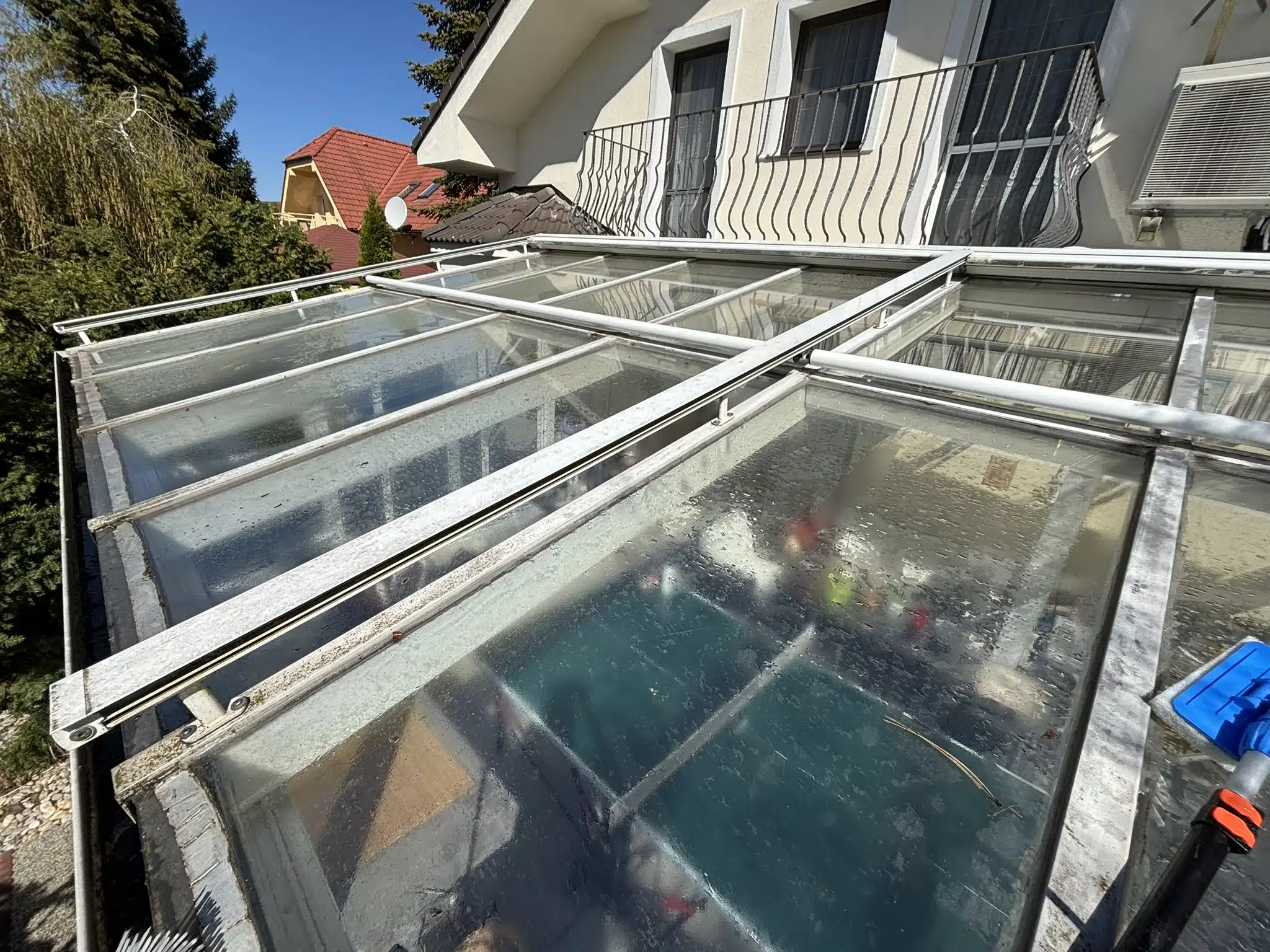
Why are the spots most visible on conservatories and roof windows?
On horizontal and sloping surfaces, water stands longer and dirt settles the most. The window manufacturer Slovaktual warns in its care instructions that dirt particles settle mostly on the horizontal surfaces of windows. On a glass roof, every spot also shows against the light.
This is what limescale looks like up close
The white spots and marks in the video were left on the glass after ordinary water dried. At first glance they look like streaks, but ordinary washing won’t remove them.
In Zálesie, we cleaned a conservatory and sloping roof windows on a house among conifers. As well as dirt, the roof windows had resin and moss on them. You’ll find the whole process in our Zálesie project.
Is it limescale or etched glass?
Not every white spot on glass is limescale. If water stands on glass for a long time, it starts to react with the glass itself. The glass manufacturer Vitro explains that water draws sodium out of the glass and gradually becomes more alkaline. When its pH reaches about 9, it starts to attack the glass surface. Lightly damaged glass can still be cleaned with acidic products; heavily damaged glass is very hard to restore.
Water running off untreated concrete or mortar can damage glass even faster. According to the glass manufacturer Viracon, such an alkaline solution can seriously etch glass within a few days. The damage has three stages:
A transparent white film appears on the glass.
The glass surface becomes iridescent or looks as if it’s covered in oil.
An irregular milky film appears on the glass, which you can no longer see through well.
In practice: if even repeated treatment with an acidic cleaner doesn’t remove the stain, the glass may be etched. Stronger chemicals or more scrubbing won’t help then, and it’s time for an expert.
How do you remove limescale from glass, step by step?
- Wash the glass first. Remove dust and grit so you don’t smear them across the glass and scratch it while cleaning.
- Protect the surroundings. An acidic cleaner doesn’t belong on the frame, seals, render or the plants below the window.
- Test the cleaner on a small area. Especially on coated or self-cleaning glass.
- Apply the acidic cleaner. Follow the instructions on the product packaging.
- Leave it to work. But don’t let it dry on the glass, so don’t clean in direct sunlight or in frost.
- Rinse the glass thoroughly. Ideally with mineral-free water, so no new minerals are left on the glass.
- Repeat as needed. Older stains often need several treatments.
For hard water stains, the glass manufacturer Pilkington lists cleaners with diluted phosphoric or oxalic acid, always followed by a rinse with clean water.

How we remove limescale
We use acidic cleaners that dissolve limescale. We apply them, leave them to work and, if still needed, scrape off the residue with a glass scraper blade.
We always finish outside windows with a rinse of demineralised water. It has nothing to leave behind, so no new spots form on the glass.
What should you avoid using to remove limescale from glass?
| Product | Why not | What to use instead |
|---|---|---|
| A razor blade, metal scraper or scouring pad on coated or self-cleaning glass | Damages the thin layer on the glass surface | An acidic cleaner and a soft sponge. If you don’t know what glass you have, don’t use a scraper |
| Abrasive creams and cream cleaners | Scratch the glass and the frame | An acidic cleaner and time to work |
| Products containing hydrofluoric acid | Etch the glass itself | A cleaner intended for glass |
| Bleach, alcohol and thinners on the frame | Damage the frame surface | A neutral cleaner with a pH of 6 to 8 |
| Toilet or bathroom cleaner without rinsing | Runs onto the render and plants below the window | Rinse thoroughly and protect the surroundings |
The GANA and IWCA associations, in their bulletin on cleaning architectural glass, warn that razor blades and metal scrapers don’t belong in routine glass cleaning and must never be used on coated glass.
Do vinegar or citric acid help?
Vinegar and citric acid are both weak acids, so they can help with fresh, thin stains. With old stains that have dried on repeatedly, they’re often not enough. In a discussion on the Slovak forum Modrý koník, the opening post says that neither undiluted vinegar left to work for 20 minutes, nor lemon, nor a pressure washer removed the spots on the windows. Contributors also point out that vinegar can damage rubber seals and that products need rinsing off thoroughly so they don’t run onto the render.
Vinegar and citric acid
On fresh stains. Leave to work, don’t let it dry, rinse and protect the frame.
Pressure washer
Water alone doesn’t dissolve minerals, so a pressure washer won’t remove limescale.
How do you stop limescale coming back on your windows?
- Point sprinklers away from the windows and don’t spray the windows with well water.
- Always squeegee the water off after washing or dry it with a cloth if you’re using tap water.
- Clean with demineralised water, which has nothing to leave on the glass once it dries.
- Clean your windows regularly. Regular cleaning prevents minerals building up, which can damage the glass.
When is it worth calling in the experts?
You can deal with a small spot on a ground-floor window yourself. It’s worth calling in the experts especially for large glazed areas and conservatories, roof windows, old dried-on stains and coated glass, where the risk of damage is greatest.
Limescale removal from glass
We remove limescale from glass on family homes around Bratislava, Senec, Pezinok and Šamorín. This is what it looks like in practice:
- an acidic cleaner that dissolves the limescale
- time to work and, if needed, a glass scraper blade
- a final rinse with demineralised water
- on request, cleaning all the windows on the same day

Frequently asked questions
How do I get limescale off a window?
Wash the glass first, then apply an acidic cleaner, leave it to work and don’t let it dry. Finally, rinse the glass thoroughly and repeat if needed. Protect the frame and seals.
Can I use toilet or bathroom cleaner on a window?
Some contain acids that dissolve limescale. Test them on a small area, protect the frame, seals and render below the window, and then rinse the glass thoroughly.
Does limescale damage glass if I leave it?
If water dries on the glass repeatedly over a long time, it can damage the glass surface. Light damage can still be cleaned, heavy damage only with great difficulty. That’s why it’s better to remove spots in good time.
Why do I have white spots on my windows from the sprinkler?
A sprinkler puts mineral-laden water on the glass. When the water dries, the minerals stay on the glass as white spots. Point the sprinkler away from the windows.
Will a pressure washer remove limescale?
No. Water alone doesn’t dissolve minerals. Limescale needs an acidic cleaner and a thorough rinse.
Can limescale be removed from a conservatory?
Yes, using the same method as for windows. But on a glass roof it’s work at height and every spot shows against the light, so it’s worth calling in the experts.

Do you have white spots on your windows that won’t come off?
Send us a few photos and we’ll prepare a quote. It’s always the two of us who come, husband and wife Betka and Patrik. Bratislava, Senec, Pezinok, Šamorín and the surrounding area.
Message Patrik on WhatsAppPatrik Ostrihoň is a co-owner of Gutt.sk. With his wife Betka, he cleans the exteriors of family homes around Bratislava, Senec, Pezinok and Šamorín: windows, blinds, gutters, paving and solar panels. More about Patrik
Sources
- RÚVZ Banská Bystrica: Tvrdosť pitnej vody vo verejných vodovodoch (in Slovak)
- Vitro Architectural Glass: How to Prevent Glass Corrosion (TD-105)
- Viracon: Glass Staining (VTT-002)
- Pilkington: Maintenance and Hand Cleaning of Pilkington Activ Self-Cleaning Glass (ATS-166)
- GANA/IWCA: Proper Procedures for Cleaning Architectural Glass Products (FB01-00, 2016)
- Slovaktual: Návod na obsluhu a údržbu hliníkových okien a dverí (2024, in Slovak)
- Modrý koník: Ako vyčistiť okná od vodného kameňa? (in Slovak)
- Gutt.sk: our test of 6 types of water in ppm
The Gutt.sk blog
Read more articles

How to clean windows without streaks: why streaks form and how to prevent them
Why do windows still have streaks after washing? We explain the three causes, a step-by-step method and why professionals clean windows with…
Read article
Gutters in autumn: what happens when they get blocked and how to clean them
Leaves and pine needles in your gutters aren't just a cosmetic problem. We explain what a blocked gutter causes, how to tell…
Read article
Pure water cleaning: what it means to clean windows and solar panels with demineralised water
Why doesn't demineralised water leave spots on glass? We measured 6 types of water in ppm and explain TDS, hardness and how…
Read article