

Leaves, pine needles and moss gradually clog eaves gutters and downpipe outlets. As long as it doesn’t rain, everything looks fine. The problem only shows during a proper downpour. I’ll explain what a blocked gutter can cause, how to tell if a downpipe is blocked and how to clean gutters safely.

Quick answer: Gutters should ideally be cleaned twice a year: in autumn once the leaves have fallen, with a check at the end of winter. In a blocked gutter, water overflows the edge, runs down the facade and can make the foundations of the house damp. If you have conifers above your house, check your gutters more often.
What happens when a gutter is blocked?
A guttering system has one job: to carry water from the roof away from the house. When the gutter is full of leaves or pine needles, the water finds another way, and it almost never goes where you’d want it to.
Why does water overflow the edge of the gutter?
When the gutter or the downpipe outlet is blocked, the water has nowhere to drain and spills over the edge of the gutter. It then runs down the facade, leaving wet patches. On top of that, dirt builds up where water stands in the gutter, forming a layer that catches more leaves, warns the Slovak portal Bývanie Hrou. You often can’t see standing water in the gutter from the ground.
Can a blocked gutter damage the facade and foundations?
Yes. Water that doesn’t drain down the downpipe falls at the base of the house and can make the foundations damp. According to the Slovak magazine Krytina.sk, this kind of damp is very hard to remove, both technically and financially. Moisture also speeds up the wear of paint and the corrosion of metal parts, and encourages moss and mould to grow. If overflowing water has already left streaks and marks on the render, the answer is facade cleaning.
What happens to a blocked gutter in winter?
Water standing in a blocked gutter can freeze in frosty weather. The ice then stops even meltwater from the snow getting into the downpipe. That’s why we recommend cleaning gutters in autumn, before the first frosts.
How can you tell that a gutter or downpipe is blocked?
A blocked gutter usually gives itself away before it causes more serious damage. Look out especially for these signs, which are also listed by the trade journal The Construction Specifier:
- Water overflows the edge of the gutter when it rains
- Wet patches and streaks on the facade
- The gutter sags between the brackets
- Dirt keeps building up in the same spot
- Water runs down the outside of the downpipe
- Water stands by the plinth and foundations of the house
A simple check: during a proper downpour, look at your gutters from the ground or from a safe spot. Heavy rain shows an overflowing gutter and leaking joints better than drizzle. Don’t climb a wet ladder or go up on the roof while it’s raining.
When a downpipe clears, you can hear it
When we clear a downpipe, we can tell by the sound too. When it unblocks, the water bubbles, gushes and gurgles, and then it just drains away calmly.
In the video, we’re clearing a downpipe that carries rainwater to a soakaway, on a job in Trnava.
When and how often should gutters be cleaned?
Guttering should ideally be cleaned twice a year. The first clean is recommended in autumn, once the leaves have fallen, so the dirt doesn’t stay in the gutters over winter. At the end of winter it’s a good idea to check the gutters and plan any repairs. Cleaning at least twice a year, in spring and autumn, is also recommended by the American magazine This Old House.
If you have conifers above your house, check your gutters more often. On a job in Trnava we saw what pine needles can do: they clogged the whole carport roof and the guttering system and blocked the gutters and the downpipes to the soakaway. You’ll find the whole process in our project unblocking downpipes in Trnava. We also came across pine needles in gutters at a house among conifers in Zálesie.

After the leaves have fallen and before the frosts. Clean the gutters, outlets and downpipes.
Check for winter damage and loose brackets and joints.
With conifers above the house and after heavy storms, when branches and leaves fall into the gutters.
How do you clean gutters safely?
Cleaning gutters is work at height, so safety comes first. The method is based on expert recommendations and our own experience:
- Don’t work alone. Work in pairs, in non-slip shoes, with gloves and eye protection.
- Put the debris in a bucket. Don’t push it into the downpipe, or you’ll block the downpipe instead of the gutter.
- Take out the strainer in the outlet and rinse it. If the downpipe has one, put it back after cleaning.
- Check the fall with water. Pour water into the far end of the gutter and watch whether it flows towards the downpipe. If it stands, the brackets need adjusting.
- Look at the joints. Leaking joints can be sealed with roofing silicone sealant.
- Don’t climb onto a wet roof. Leave cleaning steep and hard-to-reach roofs to the professionals.
We vacuum gutters rather than flushing them
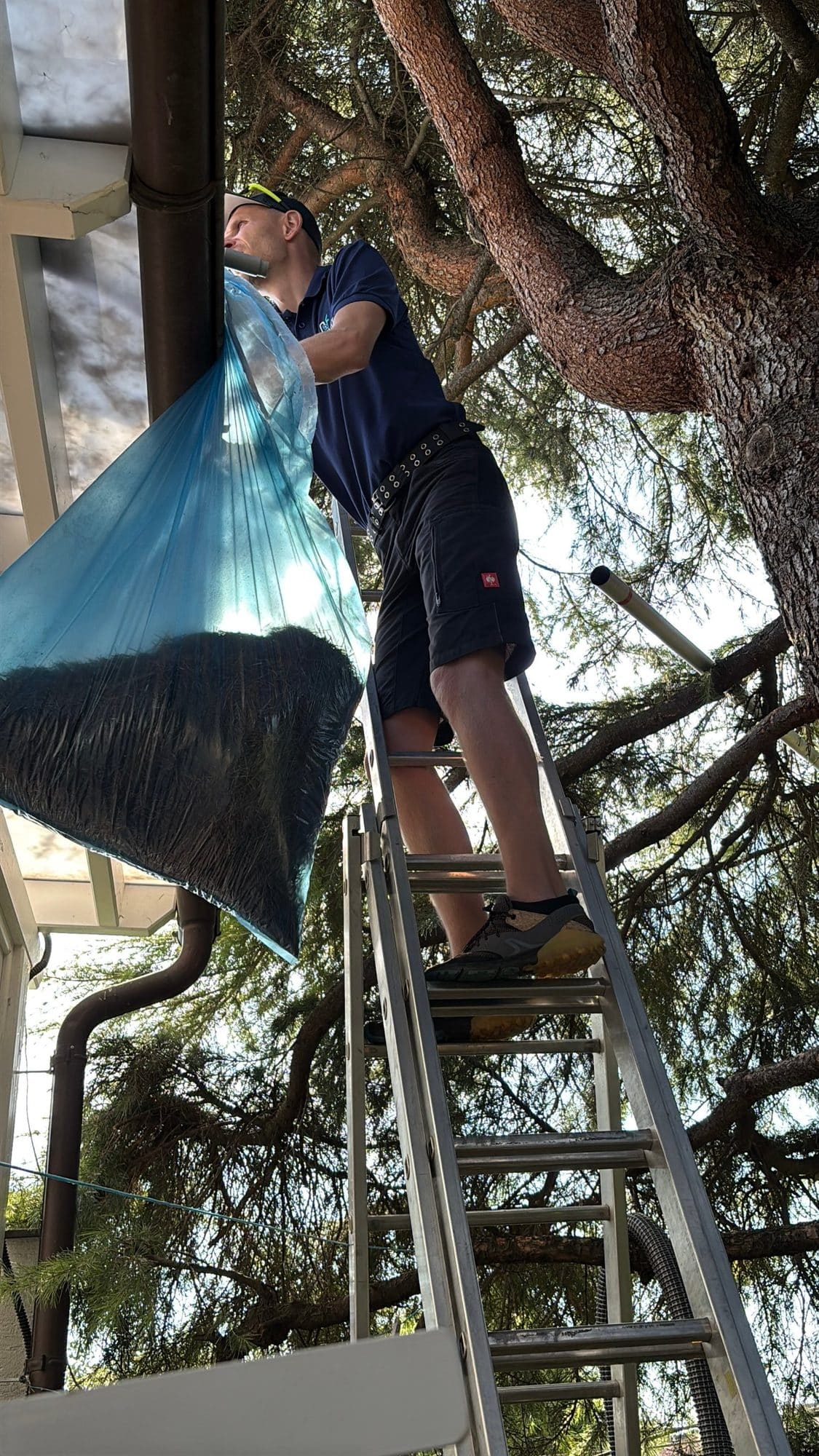
We vacuum the debris out of the gutters and the downpipe outlets with a vacuum on a long extension. That way the pine needles and leaves end up in the vacuum, not in the downpipe, where they could block it.
Only once the gutter is empty do we check with water that it drains as it should.
What should you do when a downpipe, or a downpipe to a soakaway, is blocked?
If the downpipe has an access cap at the bottom, open it and check whether there’s any debris inside. If it doesn’t, the downpipe can be taken apart and the debris removed by hand. Pressurised water can help too.
It’s harder with downpipes that carry water underground to a soakaway or sewer. Without the right tools you can’t reach the blockage there.
From our experience: in Trnava, pine needles blocked the downpipes to the soakaway. We went through them with a long drain hose with pressure jetting. We unblocked the main downpipe and the water started draining again. The next downpipe even had a stone stuck in it, and the third was partly clogged. We cleaned all three and cleared them all the way to the soakaway.
Does a gutter guard or cover help?
A gutter guard reduces the amount of leaves in the gutter, but it doesn’t remove the need for maintenance. Small particles, such as pine needles and grit from the roof covering, still get through it or get caught on it. A blocked guard can then cause overflowing just like a blocked gutter. How often to clean each type:
2 to 4 times a year
Fine particles get through, and by the end of the year sludge can settle in the gutter. Leaves stay lying on the mesh.
1 to 2 times a year
Catches more, but fine pine needles can build up on it. When cleaning, check for deposits underneath it too.
Brush and foam inserts should be cleaned three to four times a year. With trees near the house, all types need checking more often.
Why does water overshoot the gutter even when it’s clean?
If the gutter is clean and water still overflows, the cause may lie elsewhere. These are the most likely:
- the gutter has an insufficient or uneven fall, or it sags between the brackets,
- the downpipe is partly blocked, often at a bend or offset,
- the gutter or downpipes are too small for that area of roof, or there are too few downpipes.
You can check the fall with water from a hose. Don’t look for a single standard fall value; it’s set by the manufacturer of the guttering system. An occasional overflow in an extreme downpour doesn’t necessarily mean there’s a fault, but if the gutter overflows in ordinary heavy rain, it’s worth having it checked. If the gutter is undersized or badly fitted, it’s no longer a question of cleaning but of an adjustment carried out by a guttering specialist.
Gutter and downpipe cleaning
We clean gutters on family homes around Bratislava, Senec, Pezinok and Šamorín. This is what it looks like in practice:
- vacuuming leaves and pine needles from gutters and outlets
- clearing blocked downpipes with a drain hose with pressure jetting
- checking with water that everything drains
- on request, washing windows, blinds or paving on the same day
Frequently asked questions
How often should gutters be cleaned?
Twice a year is recommended: in autumn after the leaves have fallen, and a check at the end of winter. If you have conifers above your house, check your gutters more often.
When is the best time to clean gutters?
In autumn, once the leaves have fallen and before the first frosts. Water standing in a blocked gutter can freeze in frosty weather.
Do gutters need cleaning even if they have a gutter guard?
Yes. A guard reduces the amount of leaves, but small particles such as pine needles and grit from the roof covering get through it or get caught on it. A micro-mesh should ideally be cleaned once or twice a year, a standard mesh two to four times.
How can I tell if a downpipe is blocked?
When it rains, water overflows the gutter at the downpipe outlet, only a weak flow comes out of the downpipe, or water stands next to it. If the downpipe has an access cap, you can open it and check.
Why does water overflow the gutter?
Most often because the gutter or the downpipe outlet is blocked. It can also be caused by an insufficient fall, a sagging gutter, a partly blocked downpipe or a gutter that’s too small for the roof.
What should I do with pine needles in the gutter?
Remove them or vacuum them out, and don’t push them into the downpipe, where they could block it. With conifers above the house, check your gutters more often than twice a year.

Are your gutters full of leaves or pine needles?
Send us a few photos and we’ll prepare a quote. It’s always the two of us who come, husband and wife Betka and Patrik. Bratislava, Senec, Pezinok, Šamorín and the surrounding area.
Message Patrik on WhatsAppPatrik Ostrihoň is a co-owner of Gutt.sk. With his wife Betka, he cleans the exteriors of family homes around Bratislava, Senec, Pezinok and Šamorín: windows, blinds, gutters, paving and solar panels. More about Patrik
Sources
- Krytina.sk: Údržba a čistenie odkvapových žľabov a zvodov (in Slovak)
- Bývanie Hrou (SITA): Odkvapy môžu vyzerať bezchybne. Tieto skryté chyby sa ukážu až počas dažďa (in Slovak)
- This Old House: Long-term maintenance for gutter guards
- The Construction Specifier: When it rains, it overflows
- Gutt.sk: Unblocking downpipes to a soakaway in Trnava
The Gutt.sk blog
Read more articles

Hard water stains on glass: why they form and how to remove them safely from windows
White spots and marks on your windows that won't go even after washing? We explain where limescale on glass comes from, how…
Read article
How to clean windows without streaks: why streaks form and how to prevent them
Why do windows still have streaks after washing? We explain the three causes, a step-by-step method and why professionals clean windows with…
Read article
Pure water cleaning: what it means to clean windows and solar panels with demineralised water
Why doesn't demineralised water leave spots on glass? We measured 6 types of water in ppm and explain TDS, hardness and how…
Read article